

Judges are freeing more ICE detainees on Long Island. Here's why others aren't using this legal move.

The young mother from Ecuador reported to a Bethpage immigration office last fall for an interview in her request for asylum, the legal right to live in the United States due to fear of her home country. She was accompanied by her husband, Manuel, and 3-year-old son, who was born here. Right after the appointment, two federal agents detained her as her family waited in the lobby.
The officers told the 30-year-old woman, whose first name is Erika, to remove her earrings and take down her hair. Officers took her phone, cash and even the hair tie around her wrist, she said in an interview.
"I felt like everything just came crashing down on me," Erika, who has lived in the country since 2021, said in Spanish. Newsday is not publishing her or her husband's last name to protect their privacy.
But Erika already had an attorney, Reuben S. Kerben, who acted fast after a call from her husband. Within hours, Kerben’s office had produced a filing asserting Erika's detention was illegal, known as a habeas corpus petition, in the federal Eastern District of New York court in Central Islip.
And within 12 days — most spent in a cramped courthouse holding room, wearing the same clothes she was arrested in — a judge granted the petition, freeing her.
Erika, who lives in Brooklyn, is one of the rapidly growing number of immigrants detained on Long Island and across the country who’ve successfully convinced judges the government jailed them illegally, bringing fresh attention to a centuries-old legal maneuver that’s become a lifeline for many swept up in President Donald Trump’s immigration crackdown.
Between Nov. 1 and Feb. 10, 108 people filed these petitions in the Eastern District — after only 19 in the first 10 months of last year, according to a Newsday analysis of federal court records.
Judges in the district, which covers Brooklyn, Queens and Long Island, have freed the petitioner in 80 of the 95 cases where they have issued decisions, the analysis showed. The other cases are ongoing or were transferred to other courts.
Nationwide, people have filed more than 19,000 habeas petitions since the start of 2025, more than three-quarters of them since November, Newsday found.
"The explosion of habeas cases is remarkable," said Peter Markowitz, an immigration law professor at Cardozo School of Law in New York City.
Habeas corpus, Latin for "produce the body," is one of the oldest tools in America’s legal system, giving judges the power to weigh whether someone’s detention is legal. So why the explosion?
The U.S. Justice Department last fall expanded use of a law allowing mandatory detention of immigrants without a bond hearing if they entered outside an official entry point, even if it was years or decades prior. Previous administrations, including during Trump’s first term, didn’t typically jail these people without additional reason, such as criminal charges against them.
Immigrants targeted for deportation had cases heard in a dedicated immigration court, but the administration’s new policy effectively cut the judges there out of the bond hearing process. Lawyers for these men and women suddenly found themselves unable to protest their detentions in immigration court, so they turned to federal court.
Habeas corpus petitions have proved effective in federal court, experts told Newsday, since their sole intent is to challenge a person’s jailing by the government, and the administration is denying bond hearings or individual review of people’s cases.
Government attorneys, for example, argued in court records that Erika's detention was lawful because, under their interpretation of immigration law, she is subject to mandatory detention and is only entitled to limited legal protections.
But as with her case, judges in the Eastern District are largely granting immigrants’ habeas corpus petitions, Newsday found, and rejecting the Trump administration’s tactic of quickly moving people between facilities — making it hard to literally "produce the body."
U.S. District Court Judge Nusrat J. Choudhury wrote in an order that Erika should not have been subject to mandatory detention because ICE paroled her into the country in 2021, entitling her to an individual review of her case. ICE violated her due process right, the judge found, since the agency arrested her without first weighing to see if she posed a public safety or flight risk.
Her detention, Choudhury wrote, was "a clear infringement of her significant liberty interest in being free from imprisonment."

Attorney Reuben S. Kerben has filed numerous petitions challenging immigrants' ICE detentions. Credit: Ed Quinn
Kerben, the immigration attorney, previously filed habeas petitions for criminal defendants, but as federal immigration policy "radically shifted," he said, they’ve also become lawyers' "go-to tool" to get immigrants out of jail.
‘You need to move so quickly’
A tiny fraction of arrested immigrants are benefiting.
More than 5,236 people had been arrested by U.S. Immigration and Customs Enforcement in New York City and surrounding suburbs, including Nassau and Suffolk counties, between Jan. 1 and Oct. 15, 2025, according to federal immigration data published by the Deportation Data Project research group and analyzed by Newsday.
ICE released data this month showing that 70,766 people were in detention nationwide, and have said nearly 3 million people had already been removed from the country. This means that fewer than 1% of people detained by ICE have been able to file petitions challenging their apprehension and jailing.
The agency did not respond to Newsday’s request for comment. A spokesperson for Eastern District prosecutors declined to comment for this story.
Immigration lawyers cite a race against the clock — petitions must be filed before an immigrant is moved outside the jurisdiction — and how most immigrants, to start, can’t access the qualified lawyers. That could be because private firms with experience in filing habeas petitions are too expensive or the pro-bono services are overwhelmed with demand.
If their clients are moved to another state, local lawyers may not be allowed to represent them there. And many immigration attorneys are likely unfamiliar with the rules of the federal courts since they typically practice in immigration court or before the federal agency, said Markowitz.
"You need to move so quickly," said Carolyn Corrado, a partner at Jadeja-Cimone Law, an immigration law firm that has offices in Hempstead and Central Islip. "You need to have a family member who's able and willing to retain an attorney, essentially immediately."
Pallvi Babbar, a Levittown-based immigration attorney, said ICE is arresting so many people at routine appointments and flying them out of state so quickly that she is drafting some clients’ filings in advance. There is added urgency, she said, because if someone is moved outside of New York courts, there is less chance for a favorable outcome.
"I have all of these petitions ready to go if they do get detained, so that we can kind of move quickly on that." Babbar said.
Similarly to Erika's case, Kerben’s firm filed a habeas petition for Juan Carlos, also an asylum-seeker from Ecuador, within a few hours of ICE agents detaining him on Nov. 24 in Patchogue. He was on his way to the bank before going to work as a dishwasher.

Ana and her son Juan Carlos in Reuben S. Kerben's office in Queens last month. Credit: Ed Quinn
Juan Carlos’ mother, Ana, said her son was stopped by immigration agents asking if he recognized someone in a photo. He came to the United States in 2022 and has a valid work permit, according to court records.
The 31-year-old — who has special needs, according to his mother — was held for 10 days, first in the Central Islip hold room, then at Metropolitan Detention Center in Brooklyn and an ICE facility in New Jersey. His petition was granted on Dec. 3 and he was freed.
"This affected my heart and now I’m scared to go out because they’re going to appear on the street again," Juan Carlos said in Spanish. Newsday is also withholding his last name at the request of his attorney, who cited a fear of harassment or retribution.
"That’s the thought I have in my head. I can’t go out."
Judges’ frustrations surface
Local federal judges said they are growing increasingly frustrated with the government’s pace of detentions, transfers and deportations.
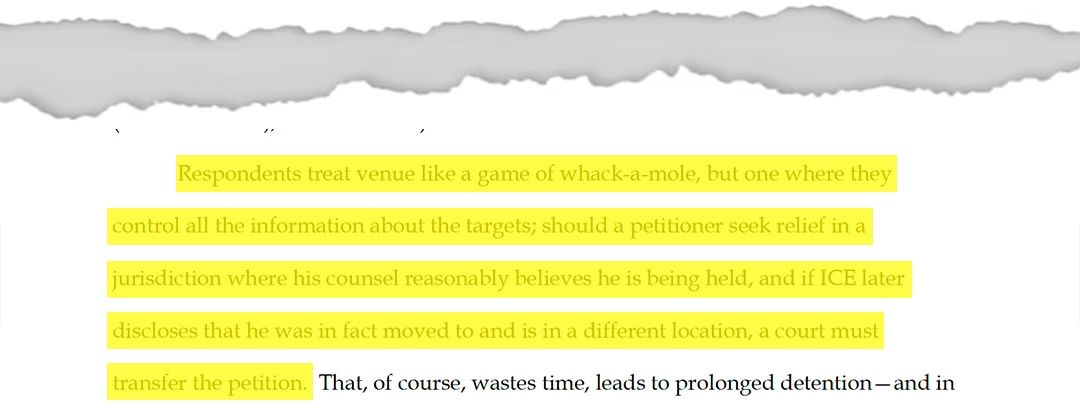
In an opinion last month that freed a detainee, Eastern District Judge Sanket J. Bulsara scolded immigration officials for treating the court "like a game of whack-a-mole, but one where they control all the information about the targets."
District Judge Sanket J. Bulsara said immigration officials are treating the courts “like a game of whack-a-mole,” moving people from place to place and leading to longer detentions.
The judge said the practice of moving detainees to different locations "wastes time, leads to prolonged detention — and in some cases, like the present one, illegal detention, given that [administration officials] freely admit they have no legal basis for the actual detention — and is contrary to any rational sense of governance, law, or court administration."
His order comes after fellow District Judge Gary R. Brown, a Trump appointee, scolded ICE late last year over the conditions at the Central Islip courthouse and prosecutors' responses. The criticism prompted the administration last month to limit how long people could stay in the hold rooms and limit their capacity.
Long Island’s top prosecutor, Joseph Nocella Jr., said in a letter to Brown that the government is establishing a "Habeas Response Team" to handle the influx of cases, including placing an attorney in the Central Islip courthouse "for the purpose of assisting with compliance and court orders."
Some judges’ decisions granting habeas corpus petitions, according to a review, are adding guardrails to ensure the government can’t go back and re-detain someone or deny them a bond hearing again in the future.
Judges in the Eastern District of New York, and elsewhere in the country, have sharply criticized the government for missing deadlines, giving inaccurate information about detainees and questioned the legality of someone without first reviewing their case.
"Judges right now are angry," said Lenni Benson, a professor of immigration and human rights law at the New York Law School. "They’re angry at the government’s inability to present the government side, they’re angry at the sloppiness of the legal arguments there."
A January analysis by Politico found that more than 300 judges nationwide have ruled against the Trump administration's mandatory detention policy, while just 14 have sided with the president.
However, on Wednesday Eastern District Judge Brian M. Cogan, who is based in Brooklyn, issued an order that sided with the administration. He said a man who entered the country illegally at the Arizona-Mexico border had no due process right, even if the administration of former President Joe Biden chose not to enforce an existing removal order.
"Between his unlawful entry in 2021 and October 2025, the Executive enforced that requirement with a velvet glove; thereafter, with an iron fist," Cogan wrote. "The former was no doubt preferable to petitioner, but was by no means required by the Due Process Clause."
Lawyers for detained immigrants say they’ll continue filing as many petitions as they can manage, suggesting the issue seems bound for higher court.
Last week, a three-judge panel for the U.S. Court of Appeals for the 5th Circuit — which covers Louisiana, Mississippi and Texas — said in a ruling that only immigrants who entered the country lawfully are entitled to a bond hearing, meaning that those who entered without an inspection can face mandatory detention without a bond hearing. The government is also appealing some judges’ rulings in the 2nd Circuit, which covers New York.
Barriers to access
With most habeas corpus petitions filed in the Eastern District so successful, why can’t more of the thousands of immigrants detained get them filed?
Advocates say a private immigration attorney can be expensive and lawyers who know how to file habeas corpus petitions and are admitted to practice in a specific federal court are scarce.
Legal fees for filing a habeas corpus petition can generally cost thousands of dollars, but lawyers typically charge a flat fee, said Kerry Bretz, a Manhattan-based immigration attorney.

Credit: Courtesy of Kerry Bretz
The availability of qualified people to do this work at a reasonable fee is not there. And that's a really sad factor.
— Kerry Bretz, immigration attorney
As for pro-bono lawyers, "a lot of them don't have the ability to entertain somebody like who just was detained today, and have the family come in and be retained on the spot," Bretz said. "The availability of qualified people to do this work at a reasonable fee is not there. And that's a really sad factor."
Paige Austin, an attorney at the advocacy group Make the Road New York, which has filed petitions on behalf of detainees, said it’s difficult for her organization to provide legal services to people once they’ve been moved by ICE to detention centers elsewhere in the country.
"As a service provider [we] can’t provide services to New Yorkers and New York families once they’re moved because we aren’t located in those other places and we don’t have attorneys admitted in those places and the rules vary by place," Austin said.
Cardozo School of Law recently launched a new program designed to train attorneys around the country in how to respond to the immigration crackdown and how to file habeas corpus cases, Markowitz said.
Before the recent immigration crackdown, Kerben — Erika’s attorney — said he’d never filed a habeas corpus petition for an immigration case. He said he felt "uncertain" filing his first last summer.
"The waters were relatively uncharted," he said.
In Erika’s petition, Kerben alleged that when his client was detained, one of the agents acknowledged it was unusual to just take someone seeking legal status with no warrant and no criminal record, but that it was "a sign of the times."
"These are people that are coming here seeking our help," Kerben told Newsday, "and to take somebody who's seeking help from you and just rip their family apart for no reason other than you're following orders and say ‘it's a sign of the times,’ it's just very disconcerting."
Erika spoke to Newsday from Kerben’s Queens office, Manuel by her side. She said her detention last fall in Bethpage changed her.
"I don’t have the confidence I had before to go out," she said, "or to go anywhere."
Newsday’s Belisa Morillo contributed to this story.
