

These Suffolk cops admitted misconduct and agreed to leave. But only after their pensions kicked in.

Suffolk County keeps police officers on the force for years despite determining their misconduct warrants departure, costing taxpayers millions of dollars, a Newsday investigation found.
The county has negotiated at least seven settlements since 2011 that let disciplined officers stay employed just long enough to reach 20 years of service and full pension eligibility, at salaries as high as $270,000, records show.
The agreements — negotiated by the police commissioner, county labor relations director and the influential officers union — raise questions that county officials refused to answer: why people they wanted gone are allowed to remain on patrol, allowed to keep collecting overtime and allowed to increase their final pension payments.
Following these settlements, the county has paid more than $7 million in salaries and overtime to these officers as they await the date they've agreed to be terminated, or to retire or resign.
WHAT NEWSDAY FOUND
- Suffolk County entered deals to delay departures of police officers who admitted misconduct, allowing them to reach pension eligibility before they depart.
- The seven officers who've gotten these deals earned more than $7 million in salary after the police department said they should be terminated.
- The unusual agreements highlight the complexities of Suffolk's police disciplinary system, in which an arbitrator holds the final say and unions hold significant influence.
One officer fabricated a Breathalyzer test for a colleague while another revealed the identity of an undercover police officer and withheld knowledge of "unlawful conduct" from the department, records show. One current officer’s "penalty of termination" was set 14 years in advance.
"This is an alarming practice that nearly completely defeats the purpose of the discipline in the first place," said Josh Parker, deputy director of policy at New York University’s Policing Project, which advocates for transparency and accountability in policing.
The settlements reflect the challenges of a police disciplinary system mandated by longstanding law enforcement collective-bargaining agreements that have been negotiated by generations of county executives and signed off on by generations of county legislators.
Here's how that system has played out in practice: An independent arbitrator, not the police commissioner, has the final say on police discipline in Suffolk. In some cases, the department has tried to fire an officer only to have the arbitrator side with the union. So with one of these settlements, the department gets the guarantee of a departure, even if it's delayed, sometimes along with other concessions.
But, experts say, that's at the expense of the taxpayer.
Joanna Schwartz, a UCLA law professor who teaches a course about police accountability and authored a book on "how the legal system prevents accountability for police misconduct," suggested that politicians are culpable because they agreed to union protections that strip them of full authority over discipline. This ensures that prompt firings happen only in the most extreme circumstances.
"It suggests to me not that their hands are tied, but that they are in charge of the extent to which their hands are tied," Schwartz said.
Since 2011, arbitrators rejected the county’s attempts to fire officers as many times as they granted them — seven, according to records the county provided in response to a Freedom of Information Law request that sought police misconduct records.
Suffolk County Executive Edward P. Romaine, Police Commissioner Kevin Catalina and the county's director of labor relations, Jennifer McNamara, all declined Newsday's multiple requests for comments seeking their rationale behind such agreements.
Lou Civello, the Suffolk Police Benevolent Association's president, acknowledged serious misconduct allegations lead to these types of delayed-termination deals. But he said the settlement agreements represent a deal that makes sense for the officer and county because it bypasses the requirement that the county must convince the independent arbitrator that the officer is guilty of the alleged misconduct and firing is appropriate.
"If the department could just fire the person right then and there, they would," he said in a phone interview. "The reason is they couldn’t. They negotiate the settlement because they think it’s in the best interest of the department."
Typically these deals are given to officers who are within a few years of reaching 20 years of service, records show.
The PBA carries significant political weight throughout Suffolk, regularly endorsing candidates, from county executive down to school board races. It funds candidates with its super PAC, the Long Island Law Enforcement Foundation, which spent more than $400,000 in 2025, according to state campaign finance records.
The PBA endorsed Romaine during his 2023 campaign for Suffolk executive, and various Suffolk police unions and associations have contributed more than $100,000 to him since 2023, records show.
Credit: Tom Lambui
If the department could just fire the person right then and there, they would.
— Lou Civello, Suffolk County Police Benevolent Association president
In the last 15 years, Suffolk reached 118 settlements in which officers acknowledged misconduct and agreed to penalties such as a demotion, an unpaid suspension or a loss of accrued time off they would otherwise have been paid upon their retirement.
"We don't ever ask for a deal where the officer has to leave the job after his 20th year," Civello added. "The county is asking us for that."
Former Suffolk County Executive Steve Bellone, who served from 2012 through 2023, did not respond to messages seeking comment.
The agreements, which Newsday obtained from the county's Labor Relations office via public records requests, rarely detail the officer’s specific misconduct.
Newsday previously obtained Internal Affairs Bureau documents from the police department and Suffolk District Attorney's Office that detailed the allegations behind two of the seven delayed-termination settlements.
Newsday has since submitted separate public records requests with the police for documents detailing the others. The department has not produced those records, saying they are working on a backlog of requests.
Continued $200G salaries
In 2012, Officer Ronald Reiter initially agreed to leave the force in 2014 in a deal that disciplined him for disclosing the identity of an undercover police officer and failing to "disclose his knowledge of unlawful conduct."
But one month before what would've been his departure date, Suffolk agreed to a new deal that removed the forced separation clause. The new deal gave the police commissioner "the authority to make a final and binding determination" regarding misconduct, instead of the case proceeding to an arbitrator. No reason is given for the change.
Reiter, currently a trustee in the Suffolk PBA, remains on the force. He did not return messages seeking comment. Suffolk paid him $263,078 in 2025, according to payroll records Newsday obtained from the county via a records request.
Suffolk police spokeswoman Dawn Schob said Reiter is assigned to the Second Precinct crime section.
Another officer, Jose Estrella, agreed in 2017 to retire or resign on the day he becomes eligible to collect his pension, which isn’t until around 2031.
Suffolk police launched an investigation into Estrella in 2015 — a little more than three years after his hire — when the FBI interviewed him as "a victim in an illegal gambling/loan shark ring" that was alleged to have occurred before his police employment, according to police internal affairs records. The department determined he violated a series of rules, such as using police computers to search license plates "for reasons other than official police business."
Estrella did not return messages seeking comment. Schob said he is assigned to Third Precinct patrol duties. Suffolk paid him $232,729 in 2025, according to payroll records.
Payroll records also show the seven officers who reached deals mandating their departure from the department at a future date continued to earn overtime during the interim period. Of the $7 million the county paid the seven officers following their settlement agreements, nearly $800,000 came from overtime. Newsday used county payroll data available through the end of 2025.
Several of the agreements explicitly attempt to limit overtime, using language that restricts the officers from working "any overtime opportunities outside of his assigned command." That meant they have less opportunity to pick up the lucrative additional shifts, according to the agreements.
Deals avoid arbitration
One of the more recent disciplinary cases decided by an arbitrator came in 2023, records show. That’s when a hearing officer rejected the county’s attempt to fire David Mascarella, who had crashed his speeding truck into another car while off duty, fracturing the skull of a 2-year-old boy.
Mascarella had refused two breath tests two hours after the August 2020 crash and told internal affairs investigators he had two or three vodka and sodas at a golf outing before the crash, Newsday previously reported.
Instead of termination, Mascarella received a more-than-18-month unpaid suspension and returned to work following the arbitrator’s decision in October 2023. Records show Mascarella retired last July after reaching his 20-year service mark.
The Suffolk police investigation of Mascarella’s actions that day also found the officer charged with giving Mascarella a breath test at the hospital, Kevin Wustenhoff, instead blew into the device himself and recorded a zero blood alcohol content.
Instead of bringing the case before an arbitrator, the county agreed in 2022 to suspend Wustenhoff for six weeks without pay and bar him from working overtime outside his command. The settlement also called for his termination — but not for another four years, when he could access his pension at 20 years and one month of service.
Wustenhoff left Suffolk police in January with 20 years and two months of service credit, according to a spokeswoman for the state comptroller’s office, which oversees the police pension system. Twenty years of service marks when a Suffolk police officer can retire and receive half their salary as a pension benefit, regardless of age.
Wustenhoff declined to answer questions about the agreement, referring a reporter to his attorney, Anthony La Pinta, who said in a statement that settlements are not unique.
"Arbitration is unpredictable and can lead to unfair decisions for either party," La Pinta said. "Negotiated agreements prevent the risk of unanticipated outcomes."
The former police commissioner who signed that deal, Rodney K. Harrison, said in a recent phone interview he was not privy to the negotiations that led to the arrangement delaying Wustenhoff’s termination by nearly four years.

Then-Suffolk Police Commissioner Rodney K. Harrison said he was not involved in a settlement, signed during his tenure, that delayed the termination of Officer Kevin Wustenhoff. Credit: Howard Schnapp
"I signed off on the termination of Wustenhoff," Harrison said. "What happened afterward is unbeknownst to me."
He said Suffolk’s Labor Relations office facilitated Wustenhoff’s agreement and "overruled" him.
When told Wustenhoff’s agreement also includes his own signature, Harrison said, "The only thing I signed off on was his termination. How my signature got on the other documents, I couldn’t tell you."
McNamara, the county’s director of labor relations who also signed the settlement, did not return messages about Harrison’s comments. She had previously declined to comment on the practice of delaying police officers' terminations, referring a reporter to Romaine spokesman Michael Martino.
Martino declined to comment.
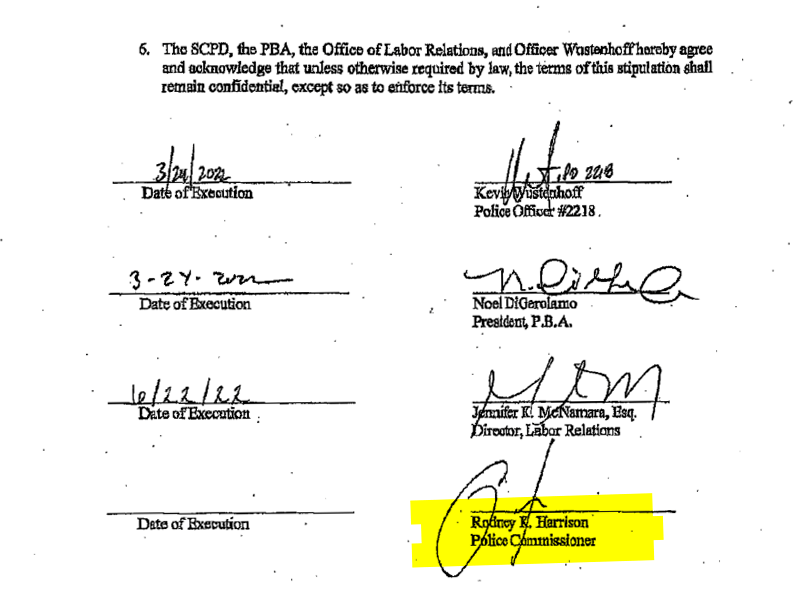
When told officer Kevin Wustenhoff’s agreement also includes his own signature, then-Suffolk police commissioner Rodney K. Harrison said, "The only thing I signed off on was his termination. How my signature got on the other documents, I couldn’t tell you."
Praise and criticism
In Nassau, Police Commissioner Patrick Ryder "makes the final determination on discipline," Nassau police spokeswoman Det. Tracey Cabey told Newsday.
Asked if Nassau, like Suffolk, also settles misconduct charges by agreeing to delay an officer’s termination until they can access their pension, Cabey said in an email: "The resolution of disciplinary matters may involve negotiation between the Department and the member’s counsel which may also include an agreed upon date of separation for the member."
Cabey declined to answer follow-up questions.
Experts who have studied police accountability throughout the nation said they had never heard of disciplinary deals that delayed an officer’s termination until they reach the service time necessary to immediately access a pension benefit.
"I haven't come across the practice specifically," said Parker, adding he would include it as an example of "worst practices for an evidence-based system of police accountability."
Added Schwartz, the UCLA law professor: "They’re able to retire with their pension. Where’s the consequence for the finding of misconduct?"
They’re able to retire with their pension. Where’s the consequence for the finding of misconduct?
— Joanna Schwartz, UCLA law professor
But not everyone agrees the deals that delay an officer’s firing are defective.
Philip Stinson, a criminal justice professor at Bowling Green State University in Ohio who has studied police misconduct, believes these clauses are used in cases the county felt demanded significant discipline but were too flawed to convince an arbitrator to fire the officer.
Stinson praised the county for orchestrating an officer’s departure outside of arbitration, which may go completely in favor of the officer.
"They're actually getting rid of somebody that they really can't get rid of," he said, while noting each of the deals also included additional discipline such as unpaid suspension and loss of accrued time off the officer would be paid for upon their termination.
Suffolk continues practice
Suffolk County agreed to a deal in September with Officer Christopher Weiner, who has about 19 years of service time, according to the state comptroller’s office.
While the misconduct that precipitated the deal is not expressly stated, the allegations were significant enough to also warrant a four-month unpaid suspension as part of the agreement.
Weiner also has been the focus of previous misconduct allegations. Following a referral from the Suffolk police commissioner, the state attorney general’s office investigated Weiner for two incidents in which he allegedly used excessive force.
In February 2022, Weiner punched a man while holding handcuffs, leaving cuts on the man’s face, according to the attorney general's findings letter. Suffolk police initially exonerated Weiner over allegations of excessive force, records show, but the attorney general's office found that punching the man was unreasonable and recommended Weiner be retrained on Suffolk’s use-of-force policies.
Four months before that incident, Weiner also turned off his body camera for 14 minutes during an altercation with a suspect at the police station, according to the attorney general's letter to Suffolk police. When he turned the camera back on, the suspect’s head was covered with a spit hood and there was blood on the floor nearby, the attorney general's letter stated.
Weiner, who will remain a Suffolk cop for another year before his forced retirement, did not return messages seeking comment. He is assigned to Second Precinct command, Schob said.
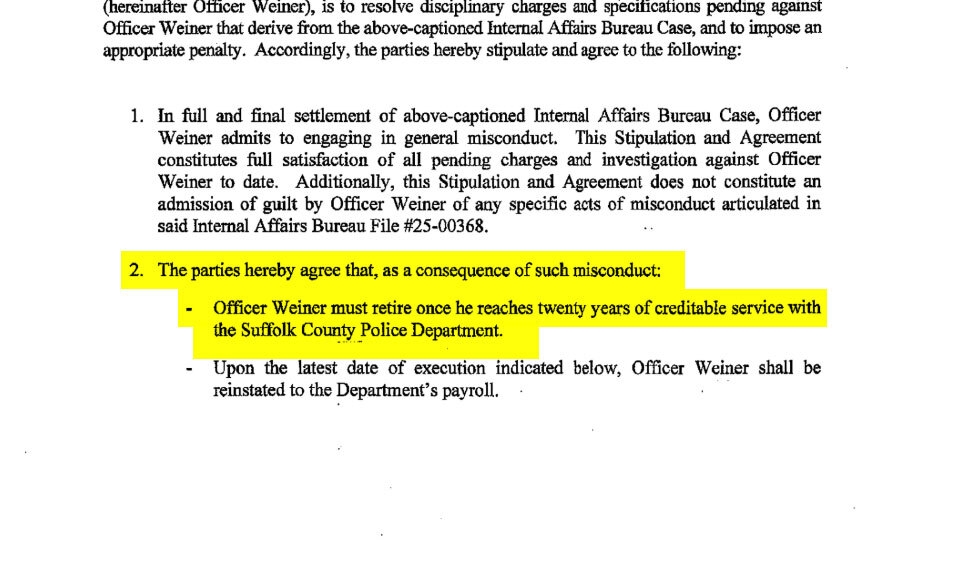
A settlement stating Officer Christopher Weiner "must retire once he reaches twenty years of creditable service with the Suffolk County Police Department."
‘Public in danger’
The Suffolk police department launched two disciplinary investigations into Wustenhoff between the time he signed his disciplinary settlement in 2022 and when he left the force in January, according to his personnel file.
A citizen complained in 2023 that Wustenhoff took improper police action and used unprofessional language. The police department exonerated him of the first charge and was unable to substantiate the second.
The following year, an administrative investigation found he had used unprofessional language in another incident.
Last year, the police department also recorded having issued him "command discipline," a form of police discipline effectively akin to a written warning.
None of the records include specific details of any of the above incidents.
One allegation against Wustenhoff during this time is part of ongoing litigation against the county. A Port Jefferson man in 2023 filed a federal lawsuit claiming Suffolk police illegally seized his guns. The complaint stated Wustenhoff made inappropriate comments when he called the man to inform him his firearms license had been suspended.
Civello rejected the idea that Suffolk's practice of keeping officers on the force after they've admitted misconduct and agreed to be terminated is a problem.
"That’s not a giveaway," the Suffolk PBA president said. "It’s a negotiated settlement where the department has the unilateral right to separate the officer from service."
But policing experts said these agreements are bad for both the public and the police department.
"Keeping these officers on the force," Parker said, "is putting members of the public in danger and tarnishing the reputation of fellow officers."
